
Wasp and Bee Control on Long Island
On Long Island, we have several species of bees and wasps. The best way for us to help you with your stinging insect infestation is to first properly identify if the insect is a wasp, bee, or something else by looking at its nesting habits. The most common bees and wasps on Long Island include:
- Paper Wasps
- Bald-Faced Hornets
- Yellow Jackets
- Digger Bees
- Carpenter Bees




Eco-Friendly Bee and Wasp Exterminators in Long Island
The removal of each particular nest is slightly different than the other types of nests. Nests of the Paper Wasp are eliminated with the application of a residual product alone while Yellow Jacket and Honey Bee nests require more rigorous treatment. These two nests require treatment with a machine called a micro-injector, designed to inject insecticide into the opening of the structure that the bees or wasps are using. The material penetrates deep into the nest, killing off the bulk of the colony at once. This same opening is then treated with residual dust, which will eliminate foraging insects as they return. The hole should never be plugged until all insects are dead. Plugging the hole will force any trapped wasps or bees, not yet affected by chemicals to exit into the house rather than back outside.
- Carpenter Bee elimination requires the injection of residual dust into the galleries. The galleries are then sealed because the bees inside will not be able to bore their way out before dying from the treatment.
- Bald-Faced Hornet nests should be approached with caution. Residual dust formulations and specialized aerosols must be injected directly into the nest opening. This will provide the quickest knockdown of the colony.
Tested and Perfected Wasp and Bee Removal
Besides the obvious damage from stings, there are several other problems associated with bees and wasps.
- Yellow jackets have been known to expand their nest so far into the wall void that they break through the sheetrock and enter into your home.
- Honey Bees can pose a threat to the walls in which they were contained even after they are removed. The honey within the nest begins to melt, often staining walls and producing a foul odor.
- Carpenter Bees also damage the wood in which they nest, often to the point of needing repair.
Call for effective pest control
Long Island is home to many different types of Wasps and Bees. Our technicians at A&C Pest are trained to identify these pests and treat the effected area. Learn more about the types of stinging insects on Long Island.
Paper Wasps
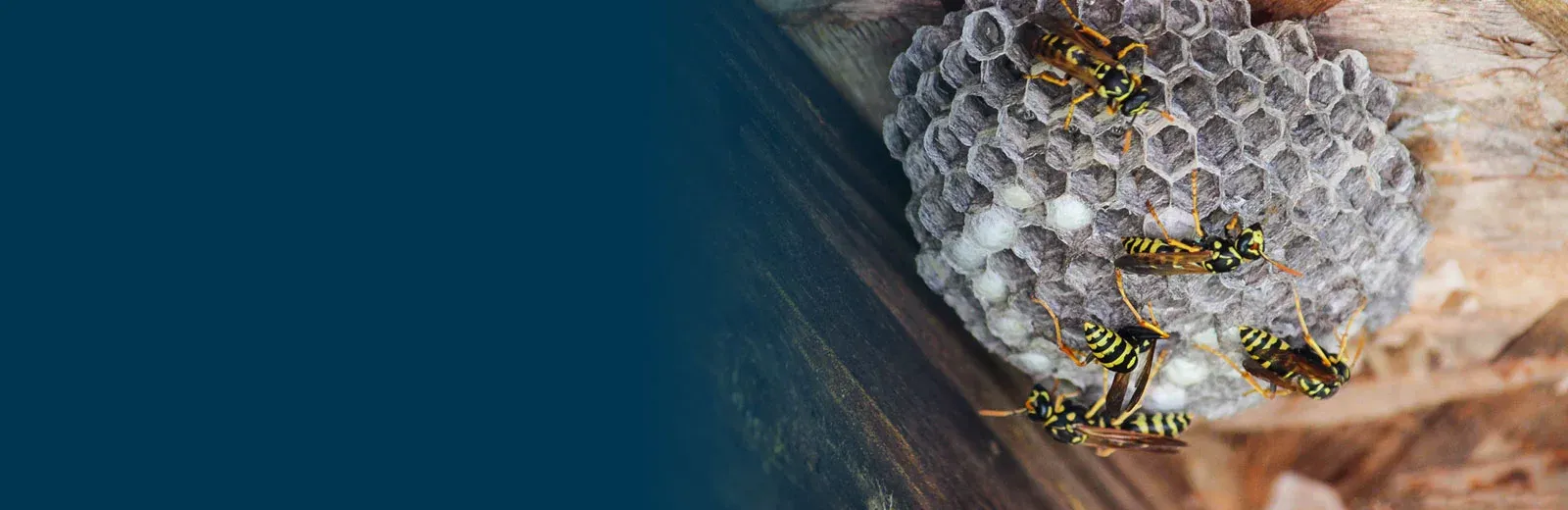
Nests are usually suspended beneath horizontal surfaces – such as the railing of desks or under overhangs. They consist of one layer of cells and rarely grow larger than 6–8 inches in diameter. Each nest can contain from 1 to several hundred wasps.
Bald-Faced Hornets
These nests are often found hanging in a tree or bush. They are large grayish carton-type nests often resembling a soccer ball. Inside are several tiers of cells. Only one opening, which is located at the lower tip, is used for entry and exit. A hornet nest can contain several hundred hornets.
Yellow Jackets
The yellow jacket nests primarily in the ground often started in an old mammal burrow. Initially, the nest is built to fill the cavity, but once established, an expansion will occur. Yellowjackets are also found nesting in wall voids, attics, or crawl spaces, utilizing a hole or crack in the exterior facing of the building as an entrance. These nests closely resemble those of the Bald-Faced Hornet but are not always visible. Each nest often contains 1,000 to 5,000 yellow jackets. Yellow jacket removal takes careful consideration, so contact a professional if you have an infestation.
Honey Bees
Nesting habits of the honey bee resemble that of the yellow jacket. Bees will enter a structure through a small opening in the exterior facing or faulty piece of flashing. Honey bee nests consist of many cells, not only for the production of immature bees but also for the storage of honey. A nest can contain as many as 20,000 to 50,000 bees.
Carpenter Bees
Carpenter Bee nests are easily distinguished from other bees because they burrow directly into the wood. They drill a perfect hole into the side of the wood, travel inward a short distance, and then make a sharp turn and travel with the grain of the wood. Often there is some staining below the hole on the siding, which further indicates nesting.
Should pests persist in between scheduled treatments, simply let us know and we'll re-service your home for no additional cost to you. That's our guarantee to you!

Wasp & Bee Control Service Area
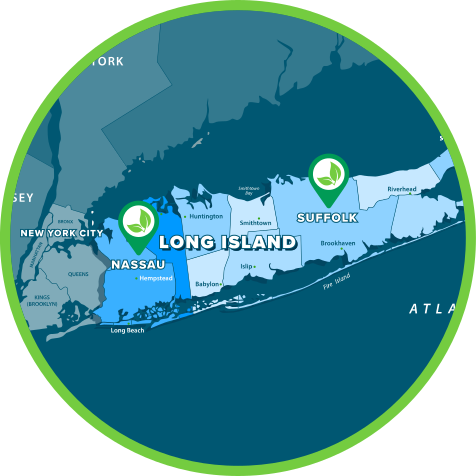
A&C has been providing exceptional service and pest management solutions to our communities on Long Island and the surrounding areas since 1969. We're proud to provide services to the following areas of Nassau County and Suffolk County.
Nassau County